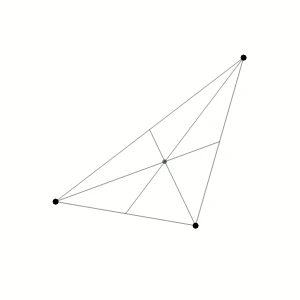
Three-Body Problem
Three suns, no orbits, one civilization on the edge of annihilation.

The Three-Body Problem is the foundational scientific and narrative conceit of Liu Cixin's Remembrance of Earth's Past trilogy. In celestial mechanics, it refers to the impossibility of finding a closed-form solution for the gravitational interaction of three bodies, producing orbits that are fundamentally chaotic and unpredictable over long timescales. In the fiction, this is not merely a math puzzle but the lived reality of an entire civilization: the Trisolaran homeworld orbits three suns whose positions can never be reliably forecast, plunging their world into repeated cycles of catastrophe and brief stability.
This single physical fact shapes every major plot thread across all three novels. It explains why the Trisolarans seek Earth, why Ye Wenjie's desperate broadcast is answered by a species in genuine existential need, why the 'Three-Body' video game becomes a recruitment tool, and why the eventual confrontation between humanity and the Trisolaran fleet carries the weight of a civilizational survival gamble rather than a simple invasion. The problem is the engine of the entire saga.
- Type
- Celestial-mechanics problem / fictional stellar system
- Number of stars
- 3
- Orbital character
- Chaotic; no stable long-term prediction possible
- Associated civilization
- Trisolaran
- First appears
- The Three-Body Problem (2008), Liu Cixin
- Narrative role
- Central conceit driving the trilogy's conflict
Lore & Background
In classical mechanics, two gravitating bodies trace clean, predictable ellipses. Add a third, and the system becomes non-integrable: tiny perturbations compound, and the configuration of the three bodies at any future moment is, in principle, unknowable. The Trisolaran system is a dramatization of this. Their three suns do not settle into a repeating dance. Instead, they occasionally cluster, flinging the planet through a 'golden age' of warmth and light, and then scatter in ways that drive the world into a 'stern time' of freezing, boiling, or tidal devastation. Civilizations rise, freeze, and restart. Over countless cycles the Trisolarans develop a culture defined by patience, endurance, and a collective memory of loss that no single generation can fully comprehend.
The chaos is not a temporary inconvenience; it is the permanent condition of their sky. There is no epoch in which the three-body configuration becomes stable enough to guarantee a comfortable future. This is what makes the Trisolaran decision to launch a fleet toward Earth so different from a typical 'alien invasion' trope: they are not conquerors in the human sense. They are refugees from a universe that will not let them rest, and their technology, while vast, is still bounded by the same gravitational physics that makes their home uninhabitable. The Three-Body Problem is thus both a physics fact and a metaphor for the fragility of any civilization that depends on a single, unpredictable environment.
In the novels, the problem also becomes a psychological and cultural tool. The 'Three-Body' game, a virtual-reality simulation of the chaotic system, is used to recruit human coordinators who understand, viscerally, what it means to live under a sky that cannot be trusted. Players who 'solve' the game—who find a temporary stable configuration—experience the same desperate relief the Trisolarans feel during a golden age, and that empathy becomes the hook for their recruitment.
In Their Own Story
The sky over Trisolaris was wrong again. Not the slow, grinding wrong of a stern time—no, this was the fast wrong, the kind where the second sun crept behind the third and the light shifted from gold to a bruised, arterial red. Old Yuen pressed her palm flat against the cooling stone of the wall and felt the vibration of the planet's crust settling into a new, unfamiliar rhythm. Around her, the settlement was quiet. No one shouted. No one ran. After so many cycles, the Trisolarans had learned that panic was a luxury of species whose suns kept their promises.
A child tugged at her sleeve and pointed upward, where the three points of light were no longer in their familiar triangle but had collapsed into a tight, trembling line. 'Golden age?' the child whispered, as if the words might make it true.
Old Yuen shook her head slowly. 'A configuration,' she said. 'And configurations end.' She turned back to the workbench, where the long-range transmitter hummed its patient, endless hum toward a small blue star so far away that its light would still be in transit when this particular arrangement of suns had long since scattered. Somewhere out there, on that wet and stable world, someone had answered. The fleet was already sailing. And the sky, as always, would not keep its word.
Reader's Guide
Before the first Trisolaran drew breath, the three stars of their system were already arguing. No orbit settled. No pattern repeated. The system simply *was*—a perpetual, intractable scramble of gravitational tugs that no equation could resolve. From this primordial chaos, the Trisolaran world inherited its defining wound: a sky that could not be trusted.
Civilizations rose in the brief golden ages when the suns happened to hold a stable triangle, and were buried in the stern times when they scattered. Each cycle erased libraries, cities, generations. What survived was not knowledge in the human sense but *endurance*—a cultural muscle memory of loss that made the Trisolarans patient, collective, and ultimately desperate. It was this desperation that made Ye Wenjie's broadcast not a provocation but a plea, and it was the Trisolaran answer that set the fleet in motion toward a blue star whose two-body orbits were, to them, almost unbearably beautiful in their predictability.
The 'Three-Body' game distilled this history into an experience: a player could feel the golden age's warmth and the stern time's cold, and understand why a species would cross the galaxy rather than endure one more cycle. Luo Ji, confronting the fleet's arrival, looked past the Trisolaran tragedy to a colder, older truth. He formulated what he called the Dark Forest theory as a law with two axioms: (1) survival is the first need of a civilization; (2) civilization grows while the universe's total matter is constant. From these follow the corollaries of mutual suspicion, the technological explosion, and the imperative of silence. The forest is dark not because there is no light, but because every creature that shines is a target. The Three-Body Problem, in the end, is the local expression of a universal condition: in a cosmos of finite resources and infinite uncertainty, no civilization can afford to be open, stable, or kind. The chaos of three suns is merely the smallest scale of a universe that will not let its inhabitants rest.
Did You Know?
- The three-body problem in real celestial mechanics has no general closed-form solution; it was a famous open challenge in 18th- and 19th-century mathematics, making it a natural springboard for a story about an unsolvabl
- In the novel, the 'Three-Body' video game is not a weapon or a mind-control tool in the traditional sci-fi sense; it is a cultural and psychological immersion that lets human players *feel* the Trisolaran experience of c
- The Trisolaran fleet's journey to Earth spans roughly four and a half centuries, meaning the civilization that launched it and the one that arrives are separated by a gap of generations that mirrors the long, patient end
- The Dark Forest theory, while presented as a logical deduction in the trilogy, echoes real astrophysical debates about the Fermi Paradox—why, if the universe is old and vast, we see so little evidence of other civilizati
More in Lore & Cosmological History
Elsewhere in the The Three-Body Problem universe
Spotted an error? Know more?
This is a living reference — every entry is fact-audited, and reader corrections feed straight into our audit queue. Suggest an edit · See this site's audit record