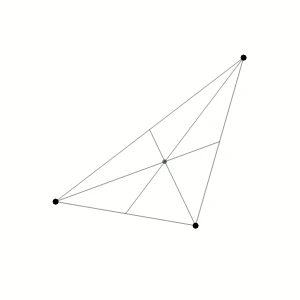
Trisolaran Three-Star System
Three suns, one planet, zero guarantees — a sky that makes apocalypse a season.

The Trisolaran Three-Star System is the home world of the Trisolaran civilization and the gravitational engine behind the entire Three-Body Problem saga. Bound by the unsolvable dynamics of three suns orbiting one another, the system alternates between long, gentle Stable Eras and violent Chaotic Eras in which the stars lunge close, scorch the planet, or drift apart and freeze it solid. This perpetual cosmic roulette is the single greatest pressure on Trisolaran biology, culture, and technology.
In the story, the system's instability is the root cause of interstellar conflict: a species that has survived eons of apocalyptic weather eventually decides its home can no longer guarantee survival, and reaches across the galaxy for a new one. Every major plot thread — the signal, the fleet, the Dark Forest logic — traces back to the simple, brutal fact that three suns make a sky no one can predict.
- Type
- Trinary (three-star) planetary system
- Defining characteristic
- Chaotic gravitational dynamics (the classical three-body problem)
- Inhabitants
- Trisolaran civilization
- Era cycle
- Stable Era ↔ Chaotic Era (unpredictable duration)
- Role in narrative
- Primary motivation for Trisolaran interstellar expansion toward Earth
- First appears
- Liu Cixin's novel The Three-Body Problem (2008)
Lore & Background
The Trisolaran system is a textbook illustration of why the three-body problem remains analytically unsolvable in classical mechanics. With three massive bodies pulling on each other simultaneously, no closed-form solution exists for their orbits. The result is a system that can appear orderly for thousands of years and then, without warning, send one or two stars into a close flyby of the third. The planet experiences these events as extreme temperature swings, radiation storms, and gravitational tides that reshape continents. The Trisolarans call the calm stretches Stable Eras and the violent ones Chaotic Eras, and their entire civilization is structured around the assumption that either can end at any moment.
This existential rhythm shaped Trisolaran biology and culture in ways that set them apart from humanity. Survival is not a philosophical ideal but a daily engineering problem. Their technology, social organization, and even their art reflect a species that has rehearsed extinction so many times it became routine. When the mathematical models of their own system finally confirmed that no future Stable Era could be guaranteed, the Trisolaran leadership made the species-level decision to seek a new home. The signal they broadcast into interstellar space was, in their own framing, a cry for coordinates — a plea from a people whose sky had run out of mercy.
The system also serves as a narrative mirror for the novel's broader themes. Just as the three suns create order through chaos, the story's characters — Ye Wenjie, the Earth-Trisolaris Organization, the Trisolaran fleet command — are thrown into orbits they cannot fully predict. The three-body problem is not merely a setting detail; it is the philosophical spine of the entire saga, a reminder that some systems are fundamentally beyond the control of the beings trapped inside them.
In Their Own Story
The sky above the Trisolaran plains held two suns that morning, close together, their light merging into a single bruised amber disc. The third hung low on the horizon, a pale coin about to slip beneath the world. Old Maren pressed her palm against the thermal glass of the observation post and felt the heat already climbing. The elders said a Chaotic Era had begun. Children in the lower terraces looked up and saw the sky redden, the way it always did, the way their grandparents' grandparents had seen it. No one screamed. You do not scream at a sky that has screamed at you for ten thousand generations. Maren keyed the relay array and began broadcasting the coordinates she had memorized, the ones pointing toward a small, blue, single-sunned world so far away it was only a rumor. She did not know if anyone would answer. She did not know if the answer would come in a century or a millennium. She knew only that the third sun was rising, and the heat was coming, and the children were watching, and the sky was about to break again.
Reader's Guide
Before the Trisolarans had a name for their sky, three suns already danced in gravitational chaos. The system's formation locked three stellar masses into a dance no equation could resolve — the eternal three-body problem. For eons, the planet cycled through Stable Eras of gentle light and Chaotic Eras of scorching passes, freezing gaps, and orbital madness. Life that survived did so by adapting to apocalypse as routine.
The Trisolaran civilization rose from those cycles, engineering resilience into every generation. But resilience has limits. When the math of their sky offered no longer-term stability, the species made a choice: leave. A signal went out into the void, a plea for coordinates. It was answered — by Ye Wenjie, a human scientist who had watched her own species commit its own kind of chaos. Her reply became the seed of a fleet that would cross the gulf between stars over centuries.
This desperation exists within a broader law the universe enforces. The Dark Forest axioms: first, survival is the prime directive of any civilization; second, the cosmos holds finite material while civilizations grow. From these two truths follows a single conclusion — every detected life is a threat to be eliminated before it can eliminate you. The Trisolarans, desperate refugees, nonetheless operate under this law. They do not broadcast. They do not negotiate. They arrive, and the forest holds its breath.
Did You Know?
- The three-body problem in celestial mechanics has no general analytical solution; the Trisolaran system is a literal dramatization of that mathematical fact, making their sky fundamentally unpredictable by the inhabitant
- In the novel, the Trisolaran world is first experienced by readers through the 'Three-Body' virtual-reality game, where players must survive the same Chaotic-Era weather patterns the Trisolarans endure, turning a physics
- The Trisolaran expansion is framed less as conquest and more as desperate migration: their home system's instability is presented as an ecological death sentence, which complicates the simple 'alien invasion' reading of
- Ye Wenjie's decision to reply to the Trisolaran signal is driven by personal trauma and a loss of faith in humanity, making the origin of the interstellar conflict a deeply human, individual choice rather than a strategi
More in Lore & Cosmological History
Elsewhere in the The Three-Body Problem universe
Spotted an error? Know more?
This is a living reference — every entry is fact-audited, and reader corrections feed straight into our audit queue. Suggest an edit · See this site's audit record