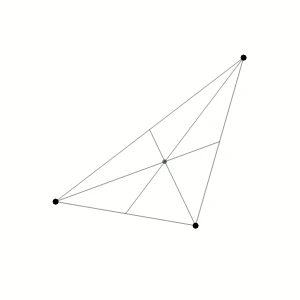
The Three-Body Game
A god's sandbox where three suns never stop rewriting the rules of survival.

The Three-Body Game is a virtual-reality experience created by the Trisolaris, the alien civilization from the chaotic three-star system of Alpha Centauri. Within the novel, it functions as both a recruitment tool for the Earth-Trisolaris Organization and a window into the existential crisis that has driven an entire species to seek a new home. The player assumes the role of a godlike figure in a primordial world, tasked with solving—or at least enduring—the perpetual orbital chaos of three suns.
It is one of the most iconic set-pieces in the trilogy, serving as a narrative device that lets the reader (and the in-world characters) experience the Trisolaris perspective directly: a civilization whose very survival hinges on an unsolvable physics problem, and whose desperation has shaped every subsequent act of contact with humanity.
- Type
- Virtual-reality game / simulation
- Creator
- Trisolaris civilization
- Purpose
- Recruitment and communication with Earth
- First appears
- The Three-Body Problem (Book 1 of the trilogy)
- Medium
- VR headset interface
- Core mechanic
- Three-star orbital chaos; player acts as a deity manipulating the world
Lore & Background
In the novel, the game is presented as a fully immersive VR experience. The player awakens in a vast, prehistoric landscape under a sky occupied by three stars instead of one. There is no fixed day-night cycle; instead, the stars drift in complex, unpredictable orbits, and the world lurches between scorching heat and freezing cold. The player, identified as a deity, can reshape the environment—summoning fire, directing water, altering terrain—to keep a small pocket of life alive. The central tension is that the three-body problem has no stable solution: configurations that appear to settle into a predictable pattern will, after a time, collapse into chaos again.
The game is structured in progressive stages or 'worlds,' each introducing a new constraint or a more violent orbital configuration. The player must adapt, experiment, and ultimately accept that no permanent fix exists—only temporary, creative workarounds. This mirrors the Trisolaris' own condition: a species that has spent millennia cycling through eras of flourishing and extinction, driven to the point of sending a signal to a distant, stable solar system. The game is, in essence, an empathy engine. It lets a human player feel what it is to live under a sky that cannot be trusted.
Within the story, the game is distributed to members of the Earth-Trisolaris Organization as a means of bonding them to the Trisolaris cause. Experiencing the helplessness of the three-body world makes the Trisolaris' request for refuge feel less like invasion and more like a plea from a drowning species. It is a masterful piece of alien propaganda, and the novel uses it to complicate the reader's moral alignment.
In Their Own Story
The headset seals over your eyes, and the world dissolves into static, then into grass. You are kneeling in wet, golden grass that stretches to a horizon with no cities, no roads, no other living things. Above you, three suns hang in a loose triangle, their light overlapping in bands of amber and white. The air is warm—too warm. You feel the heat pressing against your forearms.
You raise your hand, and the grass beneath your palms ignites in a slow, blue-white ring. The fire spreads, then you stop it, and the grass is black and still. A second sun is already climbing. The first is sinking. You watch the geometry of their orbits and feel, in your chest, the particular dread of a pattern that will not hold.
You build a river. You dam it. You let it flood the lowlands where a single, stubborn tree has taken root. The tree survives. The suns shift. The river freezes over in a single afternoon, the ice cracking with a sound like a bone breaking. You are a god here, but the sky does not care what you think of it.
Somewhere beyond the headset, in a cold apartment in Beijing, a man removes the visor and stares at his hands as though they belong to someone else. He does not sleep that night. He writes a number on a scrap of paper and sends it to a stranger.
Reader's Guide
The Three-Body Game is a VR simulation experienced through a headset. Upon entering, the player finds themselves in a vast, untamed landscape under a sky with three suns. There are no NPCs, no dialogue trees, and no explicit quest markers. The only objective is implicit: keep the world from being destroyed by the next orbital shift.
The player's powers are godlike but bounded. You can ignite areas, redirect water, raise or lower terrain, and in later stages, manipulate more abstract elements. However, you cannot alter the stars' orbits. The three-body problem is the fixed rule of the simulation; everything else is your canvas.
The game progresses through distinct 'worlds,' each with a more chaotic stellar configuration. In early stages, the orbits are slow and the player has time to react. In later stages, the shifts are violent and rapid, and the landscape is more barren. The player must experiment, fail, and adapt. There is no 'winning' in the traditional sense—there is only surviving the next cycle.
In the novel, the game is wielded by the Trisolaris as a recruitment and empathy tool. It is distributed to members of the Earth-Trisolaris Organization. The intended effect is to make the player feel the Trisolaris' desperation firsthand, transforming the alien species from a potential threat into a sympathetic, desperate neighbor. It is the most effective piece of alien persuasion in the trilogy.
Did You Know?
- The Three-Body Game is structured as a series of escalating 'worlds,' each with a more violent and unpredictable three-star configuration, mirroring the Trisolaris' own history of civilizational collapse and rebirth.
- The game serves a dual narrative purpose: it is both an in-world recruitment tool for the Earth-Trisolaris Organization and Liu Cixin's method of letting the reader experience the Trisolaris' existential crisis from the
- The player's godlike powers in the game are deliberately constrained—they can reshape the environment but cannot alter the stars' orbits, reinforcing the theme that some problems are fundamental and cannot be engineered
- The game's design philosophy echoes the real three-body problem in celestial mechanics: a system of three gravitationally interacting bodies has no general closed-form solution, making long-term prediction impossible.
More in Powers & Artifacts
Spotted an error? Know more?
This is a living reference — every entry is fact-audited, and reader corrections feed straight into our audit queue. Suggest an edit · See this site's audit record