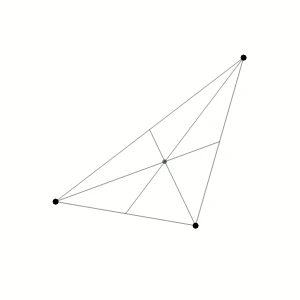
The Three-Body Problem Game
Three suns, no seasons, one species that learned to play dead.

The Three-Body Problem game (三体) is a fictional massively multiplayer online video game that appears in the first novel of Liu Cixin's trilogy. Conceived and secretly deployed by the Trisolaris civilization, it masquerades as an ordinary sci-fi MMO but functions as a long-term recruitment and identification tool. Players are dropped into a world governed by three suns whose chaotic orbits produce unpredictable freeze eras and runaway eras, forcing them to adapt, build civilizations, and ultimately confront the unsolvable three-body problem that haunts their host species.
Within the narrative, the game serves as the primary lens through which readers experience Trisolaris culture and the philosophical weight of the three-body problem. It is the arena where Luo Ji first grasps the futility of predicting three suns, and where the novel's central question—whether a species can ever escape its own chaotic environment—becomes viscerally felt. The game's eventual shutdown marks a turning point, revealing that the fun was never the point; the players were the product.
- Type
- Massively multiplayer online video game (fictional)
- Creator
- Trisolaris civilization
- Key in-universe player
- Luo Ji
- Central figure in its origin
- Ye Wenjie
- In-game setting
- A world with three chaotic suns (freeze eras / runaway eras)
- Narrative purpose
- Recruitment and identification of Trisolaris agents on Earth
- Primary appearance
- First novel (The Three-Body Problem, 2006)
Lore & Background
In the game's world, three suns of varying mass orbit one another in a gravitational chaos that defies any long-term prediction. When the suns cluster, the world plunges into a freeze era: temperatures crash, oceans lock in ice, and every living thing must hunker down, ration stored heat, and wait. When the suns scatter, a runaway era follows: the sky burns, the ground cracks, and the atmosphere turns toxic. Civilizations in the game rise and fall across these swings, and players who survive long enough begin to notice that the three-body 'civilization'—the native Trisolaris species—has spent millennia trying to solve the very problem that makes their world uninhabitable. Their solution, as the game slowly reveals, is not to solve the orbits but to leave them.
The game's mechanics mirror the Trisolaris condition with deliberate cruelty. There is no stable day, no reliable harvest, no architecture that can be trusted for more than a season. Players who master the rhythm of freeze and runaway develop a kind of patience that the novel's prose describes as alien to human intuition. This is exactly the quality Trisolaris is screening for: a mind that can accept chaos as a permanent state rather than a problem to be solved. The game is, in effect, a Rorschach test rendered in polygons and particle effects.
Ye Wenjie's role is the quiet, terrifying keystone. Her act of broadcasting a response to the Trisolaris signal during the Cultural Revolution era set the entire chain in motion, and the game is one of the first tangible fruits of that contact. She is never seen inside the game in the novel, but her shadow falls over every login screen, every freeze-era countdown, every player who stares at three suns and feels, for the first time, that the universe is not a puzzle to be cracked but a weather system to be endured.
In Their Own Story
The server room hums at 2 a.m., blue light pooling on Luo Ji's face like shallow water. On his monitor, the third sun is falling. Not setting—falling, tumbling through the sky in a slow, drunken arc while the first two grind past each other in a whisper of gravitational tides. The in-game chat scrolls with panic: *freeze in four minutes, get to the caves, get to the caves, get to the caves.* He does not type back. He has stopped typing back three eras ago. He just watches the temperature gauge tick downward, 12°, 9°, 6°, and he thinks about Ye Wenjie's face in the photograph, the one the Security Bureau showed him, and how her eyes held the same flat, patient look he feels in his own chest right now. The world freezes. The chat goes quiet. And in the silence, three suns hang in the black sky like a question no one will ever answer, and Luo Ji logs out, and the cursor blinks, and the room is just a room, and the night is just a night, and the three-body problem is just a problem, and he is just a man who played a game and understood, for one cold minute, what it means to be a species that cannot predict tomorrow.
Reader's Guide
Cultural Revolution era: Ye Wenjie, working at the Red Coast Base, intercepts a Trisolaris broadcast and chooses to respond. This single act—compressed by Liu Cixin into a handful of pages—ignites a 450-year countdown. The novel skips the intervening decades entirely; we do not see the game being designed, coded, or tested. It simply exists when the 2007 narrative present begins, already populated, already ancient in its mechanics.
2007 (first-book present): The game is live. Luo Ji, a physics researcher under Security Bureau surveillance, is drawn into it almost by accident. He plays through freeze eras and runaway eras, watches the three-body civilization struggle, and slowly internalizes the core lesson: the three-body problem has no solution, only endurance. The game's chat rooms, guilds, and in-game politics are rendered in brisk, almost documentary prose—Liu Cixin compresses what would be thousands of hours of play into a few chapters, letting the reader feel the rhythm without the tedium.
Shut-down and aftermath: Authorities identify the game as a Trisolaris recruitment vector. It is pulled from servers. Players who showed the right pattern of adaptation—those who thrived in chaos rather than fighting it—are quietly flagged. The game's death is the first visible crack in the Trisolaris plan, but the damage is done: the seed of the three-body mindset has been planted in a handful of human minds.
Broader timeline: The game does not reappear in the second or third books. Its function is complete. The 22nd-century and heat-death arcs that follow belong to Luo Ji's Dark Forest Theory and the Trisolaris fleet's long voyage, but the philosophical groundwork—accepting chaos, abandoning prediction, preparing for an enemy that thinks in centuries—was laid in a server room at 2 a.m. Liu Cixin's compression here is deliberate: the game is a prologue, a compressed myth, and the novel trusts the reader to feel the weight of 200,000 years in a single freeze era.
Did You Know?
- The game's core mechanic—three suns producing unpredictable freeze and runaway eras—is a direct dramatization of the actual three-body problem in celestial mechanics, where three gravitationally interacting bodies have n
- Ye Wenjie is never shown playing the game in the novel, yet her Cultural Revolution-era decision to answer the Trisolaris signal is the causal origin of the entire game, its players, and the 450-year invasion countdown.
- Liu Cixin uses the game as a narrative shortcut: what would be thousands of hours of MMO gameplay is compressed into a few dense chapters, letting the reader absorb the three-body philosophy without simulating it.
- The game's purpose is not entertainment but psychological screening. Trisolaris is looking for human minds that can accept permanent chaos as a baseline condition—a temperament the novel argues is fundamentally alien to
More in Narrative Arcs & Timeline
Elsewhere in the The Three-Body Problem universe
Spotted an error? Know more?
This is a living reference — every entry is fact-audited, and reader corrections feed straight into our audit queue. Suggest an edit · See this site's audit record