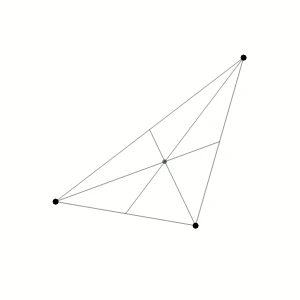
The Sophon Lock
A two-dimensional ghost that locks the mind of an entire civilization.

The Sophon Lock—often called the Sphinx in the novel—is the Trisolaran civilization's most insidious weapon against humanity: not a bomb, not a fleet, but a logical and physical straitjacket placed around Earth's entire scientific enterprise. Woven from two-dimensional particles unfolded into three-dimensional space, the Sophons operate at the quantum level to create paradoxes that make the Three-Body Problem unsolvable and to sabotage every particle accelerator on the planet. In effect, the Trisolarans do not merely delay human progress; they lock it in place, freezing fundamental physics at a level where a superior civilization can still be defeated.
Within the trilogy's architecture, the Sophon Lock is the hinge on which the entire 200,000-year conflict turns. It explains why, despite decades of warning, human science never achieves the breakthroughs needed to counter a Type II or Type III civilization. It is the reason the story's stakes feel so absolute: the enemy has not sent an army yet, but has already won the war of knowledge.
- Subject
- Sophon Lock (the Sphinx)
- Created by
- Trisolaran civilization
- Purpose
- Prevent Earth from solving the Three-Body Problem and lock fundamental physics
- Mechanism
- Quantum-level matter manipulation by two-dimensional particles unfolded into 3D
- First appears
- The Three-Body Problem (Book 1 of the trilogy)
- Status
- Active and unbroken throughout the full trilogy
Lore & Background
In the physics of the Trisolaran world, the Sophon is not a creature or a machine in any familiar sense. It is a fundamental particle—originally confined to a two-dimensional plane—that has been unfolded, like a flat sheet of paper creased into a cube, into the three dimensions of human space. Once unfolded, it can travel at the speed of light, perceive the full three-dimensional environment, and most critically, manipulate the arrangement of matter at the quantum scale. The Trisolarans deploy vast numbers of these particles around Earth, and from that vantage they can nudge the outcomes of subatomic experiments, introduce infinitesimal errors into accelerator data, and—most terrifyingly—construct logical paradoxes in a human mind.
The Sphinx is the conceptual core of this capability. Rather than simply destroying a laboratory, the Sophons engineer a situation in which the Three-Body Problem becomes provably unsolvable: any mathematical framework a human physicist builds to predict the chaotic orbits of three gravitationally interacting bodies is quietly corrupted at the quantum level, producing results that contradict their own axioms. The result is not ignorance but a locked door. The Trisolarans do not need to hide their technology; they simply ensure that the key to understanding it can never be forged. This is a fundamentally different kind of warfare, one that operates in the domain of logic rather than matter.
The broader 'lock' on science extends beyond the Three-Body Problem itself. Particle accelerators worldwide produce data riddled with inexplicable anomalies, and every attempt to push fundamental physics forward runs into the same wall. The Trisolarans have effectively placed a ceiling on human knowledge, and that ceiling is not a wall you can climb over—it is a rule of the game, written into the behavior of subatomic particles. The horror of the Sophon Lock is that it is invisible, patient, and absolute. It does not announce itself. It simply makes the universe slightly less solvable, every day, for two centuries.
In Their Own Story
The accelerator at CERN has been producing garbage for eleven months, and Dr. Lena Vasik has stopped sleeping. Not because the data is wrong—well, yes, it is wrong, but that is not the point. The point is that the errors are *consistent*. They repeat with a precision that no mechanical fault, no software bug, no human error could produce. They repeat like a fingerprint. Like a signature.
She pulls up the Fourier analysis of the noise floor, the one she runs every night out of habit, and there it is again: a pattern nested inside the pattern, a structure that should not exist in random thermal fluctuation. She stares at it for a long time. Then she opens her notebook to the page where she wrote, in red ink, the word *Sphinx*, and she draws a small circle around it. She does not write anything else. She does not need to.
Somewhere outside the laboratory, in the space between the electrons in her desk, a two-dimensional sheet of folded light is watching. It has been watching for a very long time. It is patient. It does not need to be anything else.
Reader's Guide
The Cultural Revolution (1960s–70s): Ye Wenjie, a physicist purged and broken by political violence, responds to an alien signal from Trisolaris. Her reply—essentially an invitation—sets the 450-year fleet in motion. This is the seed; the Sophon Lock is the fruit that will not ripen for centuries.
2007 (Book 1): The Three-Body Game surfaces online. The truth about the Trisolaran fleet, the Sophons, and the Sphinx is revealed to a small group of scientists and military officials. The lock on particle physics is confirmed: every accelerator on Earth is producing corrupted data. The Trisolarans have not attacked; they have *edited* the rules. Liu Cixin compresses decades of quiet scientific frustration into a single, devastating revelation.
22nd century (Book 2, *The Dark Forest*): The lock persists. Humanity builds its military and diplomatic apparatus around the assumption that the Trisolaran fleet will arrive, but the scientific ceiling remains. The Sophons continue their quantum-level sabotage. Time is skipped in large, deliberate jumps—Liu Cixin moves from the 2007 revelation to the 22nd-century fleet crisis without dwelling on the intervening centuries of locked progress. The reader is meant to feel the weight of that silence.
Heat death and beyond (Book 3, *Death's End*): The Sophon Lock's legacy echoes into the far future. The Trisolaran civilization itself has evolved, and the original particles that once guarded Earth are relics of a smaller, younger conflict. The lock, which once seemed absolute, becomes a footnote in a cosmic history that spans the thermal death of the universe. Liu Cixin again skips vast stretches of time, reminding the reader that the Sophon Lock was not the end of the story—only the beginning of a much longer, much colder one.
Did You Know?
- The Sophons are described as fundamentally two-dimensional particles that have been 'unfolded' into three-dimensional space, making them perceptible and manipulable in the human world.
- The Sphinx is not a physical barrier but a logical paradox: the Sophons corrupt the quantum-level outcomes of experiments so that the Three-Body Problem becomes mathematically unsolvable, not merely unsolved.
- The lock on Earth's science specifically targets particle physics and accelerator-based research, leaving engineering and applied sciences relatively untouched—a deliberate choice to cap fundamental understanding while a
- The Sophons can travel at the speed of light, meaning the Trisolarans can observe and manipulate events across the entire Earth system in near real-time, making any attempt to hide or deceive them effectively impossible.
More in Narrative Arcs & Timeline
Elsewhere in the The Three-Body Problem universe
Spotted an error? Know more?
This is a living reference — every entry is fact-audited, and reader corrections feed straight into our audit queue. Suggest an edit · See this site's audit record