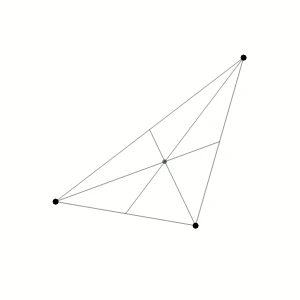
The Three-Body game world
A civilization's entire history compressed into a game you cannot quit.

The Three-Body game (三体游戏) is an immersive virtual-reality experience that surfaces on screens in the first volume of Liu Cixin's trilogy. It depicts the full geological and civilizational history of a world orbiting three suns, cycling through long stretches of chaos and brief windows of stability. In the narrative it functions as a recruitment and indoctrination tool: by letting a human player live through the Trisolarans' millennia of suffering, it forges empathy for a civilization desperate enough to reach across interstellar space for a new home.
The game is most closely associated with astrophysicist Wang Miao, who is drawn into its sessions against his will, and it is the narrative vehicle through which readers witness the Trisolaran perspective before the story pivots to the broader cosmic threat. It blurs the line between entertainment, propaganda, and genuine historical record, leaving the player (and the reader) uncertain whether what they are watching is a simulation, a memory, or a carefully constructed argument.
- Type
- Immersive VR game / propaganda interface
- Setting depicted
- A planetary system with three suns
- Primary player (novel)
- Wang Miao
- Narrative purpose
- Recruitment and empathy-building for the Earth Trisolaris movement
- Implied origin
- Trisolaran civilization
- Status in story
- Appears intermittently; its source is never fully explained
Lore & Background
In the game, the player inhabits a world where three suns move in an unpredictable gravitational dance. There is no fixed year, no reliable season. The 'chaotic era' (乱纪元) can last for generations: suns vanish, temperatures plummet, storms of unimaginable violence scour the surface, and the Trisolaran civilization is forced into a state of suspended animation, huddling in underground shelters while the surface becomes uninhabitable. When the suns finally align in a configuration that permits warmth and light, a 'stable era' (恒纪元) begins—but it is brief, measured in decades at most, and its end is as sudden and catastrophic as its arrival.
The most harrowing segment is the 'frozen world' (冰河时代), in which all three suns retreat simultaneously and the planet locks into an ice age so severe that the Trisolarans nearly lose their entire species. The game renders this not as a distant historical footnote but as a lived, sensory experience: the player feels the cold, watches the oceans freeze, and witnesses the desperate engineering and social reorganization required to survive. The emotional payload is clear: this is a people who have been punished by their own star system for thousands of generations, and their decision to send a signal into the void is framed not as aggression but as survival.
The game's meta-function is as important as its content. It is never explained who installed it, how it bypasses security protocols, or why it targets specific individuals. This ambiguity is deliberate in the narrative: the game operates as a Trojan horse of ideology, seeding the player with the conviction that the Trisolaran cause is just before the player even knows a Trisolaran cause exists. It is, in effect, the most sophisticated piece of psychological warfare in the trilogy, delivered not through force but through narrative empathy.
In Their Own Story
The screen flickers to life at 2 a.m. Wang Miao did not open it. The interface is already there, warm and waiting, as if it has been running for hours. A title card in a script he has never seen resolves, word by word, into meaning he somehow understands: *The Frozen World, Year 4,721 of the Chaotic Era.*
He is standing on a plain of black ice. Above, the sky is a void so deep it feels like pressure against his eardrums. Three suns—no, two, one—drift in and out of visibility like a slow, maddening blink. The cold is not a temperature; it is a texture, a weight, a sound, a taste of metal on the back of his tongue. He can see his own breath crystallizing before it reaches his nose.
Somewhere below the ice, he knows, thousands of Trisolarans are sleeping in a state that is not quite death, waiting for a sun to come back. They have been waiting, in this era, for four hundred years.
The game does not ask him to save them. It simply lets him stand in the cold, and lets him understand why they would send a message to a blue dot forty light-years away, and why they would wait four hundred years for an answer.
Reader's Guide
The game world operates at several nested scales, each one a self-contained environment with its own physical rules.
**The Three-Sun System.** The base layer is a planetary world orbiting three stars whose mutual gravity produces no stable orbit. There is no fixed year. Seasons do not recur; they are random events. The physical rule that governs everything here is gravitational chaos: the same configuration of suns will never repeat, so no long-term climate model is possible. This differs from any 'normal' solar system the player might imagine, where a single star gives predictable seasons.
**The Chaotic Era (乱纪元).** When the suns scatter, the surface becomes lethal. Temperatures swing from scorching to sub-zero within hours. The player's environment shifts from open landscape to enclosed shelter, and the narrative function is to establish the civilizational cost of instability—engineering, rationing, social collapse.
**The Frozen World (冰河时代).** A sub-state of the chaotic era in which all three suns are simultaneously absent. The planet freezes solid. The rule here is total thermal loss; the narrative function is to create the emotional climax of the game and the moral justification for the Trisolarans' interstellar reach.
**The Stable Era (恒纪元).** A brief window in which the suns align favorably. The environment opens up: green growth, liquid water, outdoor life. It differs from the previous scales by its scarcity and brevity, serving as the 'reward' that makes the suffering bearable.
**The Meta-Layer.** Above all physical scales sits the game's interface itself—the screen, the login, the targeting of specific players. This layer has no physical rules; its function is purely narrative and psychological, framing everything beneath it as an argument rather than a simulation.
Did You Know?
- The game is never explained as a product of any human technology or company; its origin is left deliberately ambiguous, implying it was delivered by the Trisolarans themselves as a pre-contact recruitment tool.
- The game's core mechanic—letting the player *feel* the frozen world rather than merely observe it—is a deliberate narrative strategy to bypass intellectual resistance and build emotional allegiance before the player unde
- Wang Miao's sessions with the game are not voluntary; the interface appears on his screens without his initiating a login, suggesting a level of access to his devices that defies conventional security.
- The game's depiction of the Trisolaran history is presented as a *record*, not a fiction, within the story's logic—implying the Trisolarans themselves authored it as a historical document for potential allies.
More in Worlds & Cosmology
Elsewhere in the The Three-Body Problem universe
Spotted an error? Know more?
This is a living reference — every entry is fact-audited, and reader corrections feed straight into our audit queue. Suggest an edit · See this site's audit record