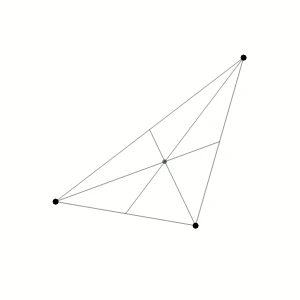
The Trisolaran world
A world condemned by three suns, where survival means leaving home.

Trisolaris is the homeworld of the Trisolaran civilization, a planet caught in the gravitational chaos of a three-star system. Unlike Earth's stable orbit around a single sun, Trisolaris is perpetually at the mercy of unpredictable gravitational interactions, cycling through 'stable eras' of habitable conditions and 'chaotic eras' in which the planet is flung between stars, frozen solid, or incinerated. This fundamental instability shaped every facet of Trisolaran culture, science, and existential purpose.
In Liu Cixin's trilogy, Trisolaris is the origin point of the central conflict: a civilization whose world is condemned to repeated destruction eventually sets its sights on Earth as a new home, deploying both a particle-level technological lock on human physics and a long-range interstellar fleet. The world is the 'why' behind the entire story—without the three-body chaos, there would be no Trisolaran crisis, no first contact, and no countdown.
- Type
- Planet in a trinary (three-star) system
- Core challenge
- Chaotic orbital mechanics (the classical three-body problem)
- Inhabitants
- Trisolaran spacefaring civilization
- Cyclical condition
- Alternating 'stable eras' and 'chaotic eras' of planetary habitability
- Threat to Earth
- Interstellar fleet (≈450-year transit) + Sophon (智子) particle lock on basic physics
- First Earth contact
- Mid-20th century (Red Coast / 红岸 era)
- Status
- Seeking a new homeworld; fleet already en route
Lore & Background
The defining feature of Trisolaris is its trinary system. Three stars of different masses orbit one another in a configuration that defies long-term prediction—the famous three-body problem in celestial mechanics. The planet's orbit is never truly stable; it may spend a 'stable era' in a comfortable zone around one star, then be yanked into a chaotic dance where it passes too close to one star (scorching) or is flung far out into the cold (freezing). Civilizations on Trisolaris have risen and been wiped out countless times by these cycles, and the species' entire cultural memory is a catalogue of lost generations.
The Trisolarans have internalized this existential threat into every layer of their civilization. Their science, engineering, and social structures are all oriented around a single question: 'How long do we have?' This urgency drove them to develop advanced technologies—nanomaterials, particle-level engineering for the Sophon—and, ultimately, to plan an interstellar migration to a stable world. Earth, with its single, predictable sun, represents the one thing Trisolaris can never offer: permanence.
A recurring theme is the 'cognitive wall' between Trisolarans and humans. Trisolaran thought is described as operating on principles that human cognition cannot fully parse; they perceive patterns and make decisions in ways that seem almost superhuman to Earth's scientists. This is not magic but a fundamentally different cognitive architecture, shaped by a world where survival demands reading an inherently unpredictable system. The Sophon lock on human basic physics is, in a sense, an extension of this gap: a civilization that has already worked around the three-body problem has no need for the kind of fundamental-physics research a stable-world civilization pursues.
In Their Own Story
The sky was wrong. That was the first thing every Trisolaran child learned to notice—not the three suns, which were simply the sky, but the way the light shifted from gold to deep amber to a cold, blue-white in the span of a single afternoon. Old Wei had seen four chaotic eras in his lifetime. He remembered the first: the ground cracking as the planet was dragged into a close pass around the largest star, the oceans boiling into rivers of steam that climbed the mountains. His grandmother's people had sealed themselves in the deep shelters and waited. Some waited. Most did not.
Now the sky was calm. One sun hung low and gold; the other two were barely visible as bright points near the horizon. The crops were growing. The children were running. Old Wei stood at the edge of the settlement, watching the two distant points of light, and doing the calculation he had made every day for sixty years: how long until the geometry changed? How long until the stable era ended? He never finished the calculation. He didn't need to. The answer was always the same: not long enough.
Reader's Guide
The Planet: A solid-surface world governed by trinary gravity. The governing rule is that no orbit is predictable beyond a short window; habitability is always temporary. Narrative function: the core 'problem' that drives the entire plot.
The Three-Star System: Zooming out, the system is a chaotic dynamical system. Stable eras are temporary attractors, not permanent states. The crisis is structural, not accidental. Narrative function: establishes the Trisolaran threat as inescapable and long-term.
The Civilization: Trisolaran technology and cognition are shaped by the need to survive unpredictability. Their decision to target Earth is a civilizational response to a civilizational-level threat. Narrative function: the 'antagonist' scale; their actions are the direct threats to humanity.
The Three-Body Game (VR): A curated simulation of Trisolaran history, experienced from the planet's surface. It is NOT the real world—it is a cultural artifact, a designed experience meant to communicate Trisolaran history to outsiders. The physical rules mirror the real system (three stars, chaotic eras), but the experience is mediated and purposeful. Narrative function: makes the abstract three-body problem visceral and personal for the reader.
Interstellar Space: At galactic scale, the Trisolaran fleet is a small, slow-moving object traversing the void. Once launched, its 450-year transit is a fixed, unalterable fact. Narrative function: the 'ticking clock'—the threat is already in motion.
The Broader Universe: In the wider trilogy, Trisolaris is one node in a vast, cold cosmos. The three-body problem is a local instance of universal physical dynamics. Narrative function: reframes the Trisolaran-Earth conflict as a small episode in a much larger, much colder cosmic story.
Did You Know?
- The classical three-body problem in celestial mechanics is a real, unsolved problem in physics—there is no general closed-form solution for three gravitationally interacting bodies, which is exactly the situation Trisola
- The Sophon (智子) is described as a proton 'unfolded' into a two-dimensional surface, etched with circuitry, then re-folded into a higher-dimensional structure—essentially a particle-level supercomputer deployed to lock hu
- In the novel, the Three-Body game is presented as a full virtual-reality experience in which players literally inhabit the Trisolaran surface and feel the temperature shifts, the light changes, and the slow dread of a ch
- The Trisolaran 'cognitive wall' (思维屏障) implies that the barrier between Trisolaran and human thought is not a matter of missing data but of structural incompatibility in how the two species process and model information.
More in Worlds & Cosmology
Elsewhere in the The Three-Body Problem universe
Spotted an error? Know more?
This is a living reference — every entry is fact-audited, and reader corrections feed straight into our audit queue. Suggest an edit · See this site's audit record