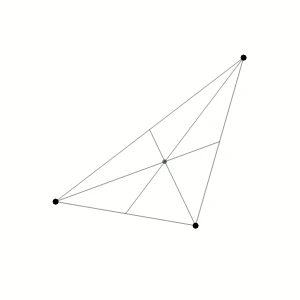
The old universe
The three-dimensional cosmos that was, before the universe was flattened into a plane.

The old universe is the three-dimensional cosmos as it existed before the catastrophic dimensional-reduction event depicted in Death's End. It is the universe of the first two novels and the opening of the third — the one in which stars burn with volume, planets trace elliptical orbits, and civilizations raise towers that have height as well as width. Its narrative role is foundational: it represents the 'normal' state of physical reality that every character takes for granted, which makes its eventual loss feel less like a natural transition and more like an erasure.
Because the old universe is the baseline, every later catastrophe in the trilogy is measured against it. The dark-forest strategy, the Trisolaran invasion, the dimensional war — all of these unfold within or against the backdrop of a cosmos that still has three spatial dimensions. When that third dimension is stripped away, the old universe ceases to exist as a physical reality, surviving only in memory, in the Small Universe, and in the reader's recollection of the first two books.
- Dimensions
- Three spatial dimensions (pre-reduction)
- Era
- Pre-Dimensional War
- Fate
- Reduced to two dimensions
- Preserved in
- The Small Universe (Little Universe)
- Key event
- Dimensional reduction attack
- Featured prominently in
- All three novels; the loss is the climax of Death's End
Lore & Background
In the strategic landscape of the old universe, the dark-forest doctrine dominates. The First Law — that survival is a civilization's primary need — and the Second Law — that the universe is a dark forest in which every civilization is a hidden hunter — together create a cosmos of radical suspicion. Civilizations in the old universe do not expand openly; they hide, they listen, they wait. This is the social and strategic texture of the universe before its physical structure is attacked.
The old universe is also the stage for the Trisolaran conflict. The three-body problem that haunts the Trisolaran homeworld — the chaotic, unpredictable motion of three stars — drives their need to leave, and the Sun's gravitational complexity is the physical backdrop against which the entire first novel unfolds. The old universe's three-dimensional geometry is what makes the three-body problem a problem at all; in a two-dimensional cosmos, the dynamics would be fundamentally different.
The dimensional reduction, when it comes, is not a slow entropy or a heat death. It is a directed act, a weapon that peels away one spatial dimension and leaves everything else as a flat cross-section. The old universe does not fade; it is cut. The narrative weight of this is enormous: the characters are not watching their world age, they are watching it be destroyed by a specific, intentional act, and the only refuge is a deliberately tiny pocket of preserved three-dimensional space that Cheng Xin and others construct as a final act of defiance against the new, flattened reality.
In Their Own Story
The last astronomer in the old universe did not get to see the end. She was calibrating a spectrograph on a mid-range world when the sky went thin. Not dark, not bright — thin. The nebula she had tracked for eleven years, a slow swirl of ionized hydrogen in the galactic arm, simply lost its depth. The hydrogen lines she had plotted in three-dimensional velocity space collapsed into a single axis. She set down her stylus, walked to the observation port, and watched the stars stretch into filaments, into threads, into a single luminous seam across what used to be the vault of the sky. The spectrograph's readout ticked down: 2.99… 2.87… 2.00. She did not scream. She had spent her career mapping the shape of the old universe, and she understood, with the cold clarity of a woman who has held too many spectra, that the shape was gone. The universe was now a drawing. And she was the only one still trying to measure its depth.
Reader's Guide
The old universe occupies the full three-dimensional space familiar to every character in the first two novels and the opening of the third. Its physical rules are the standard ones: matter occupies volume, light travels in straight lines, and objects possess depth as well as width and height. This is the baseline against which every later catastrophe is measured.
The dimensional reduction event, depicted in Death's End, strips one spatial dimension from the cosmos. What remains is a two-dimensional plane. The old universe's three-dimensional geometry — the thing that allowed stars to have volume and civilizations to build in depth — is gone. Narratively, this loss makes the stakes feel irreversible: you cannot un-flatten a universe.
Within the old universe's physics, the Three-Body Game (the virtual-reality simulation in the first novel) operates as a closed computational environment running on three-dimensional hardware. It does not alter the surrounding cosmos. Trisolaran space — the real system around Trisolaris — likewise obeys the same three-dimensional rules. The game is a model, not a separate realm.
The Small Universe, created near the end of Death's End, is a preserved pocket of three-dimensional space embedded within the two-dimensional new universe. It serves as a narrative refuge: proof that the old universe's rules can be maintained, however small the territory. The escalating scope moves from a single solar system to the whole galaxy, to the entire cosmos, and finally to a deliberately tiny bubble of preserved dimensionality.
Did You Know?
- The dark-forest doctrine — survival as primary need, the universe as a hidden hunting ground — is the strategic framework that shapes civilization in the old universe long before the dimensional war ever begins.
- The Three-Body Game, the immersive virtual-reality simulation in the first novel, is a computational model running inside the old universe's three-dimensional physics; it is not a separate dimension or alternate reality.
- Cheng Xin, the protagonist of the second and third novels, is directly involved in the creation of the Small Universe as a deliberate act to preserve three-dimensional space against the new two-dimensional cosmos.
- The dimensional reduction is framed as a directed weapon rather than a natural process, making the old universe's destruction an act of violence rather than entropy — a choice made by someone, not a law of physics runnin
More in Worlds & Cosmology
Elsewhere in the The Three-Body Problem universe
Spotted an error? Know more?
This is a living reference — every entry is fact-audited, and reader corrections feed straight into our audit queue. Suggest an edit · See this site's audit record