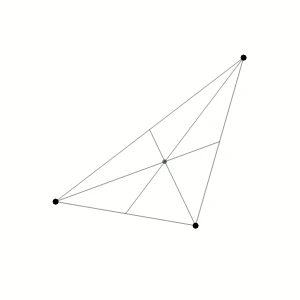
Two-dimensional space
When the universe loses a dimension, every world becomes a painting that can never be unmade.

In the final volume of Liu Cixin's Three-Body Problem trilogy, the universe itself becomes a weapon. The so-called 'second-dimensional state' (二维) is the condition in which three spatial dimensions collapse into two, flattening all matter into an infinitely thin plane. It is not a place one travels to so much as a terminal phase of reality—a dimensionality reduction that the civilizations of the dark forest deploy as the ultimate act of annihilation, rendering every three-dimensional structure into a two-dimensional smear that can never be restored.
This concept gives the trilogy's cosmology its most vertiginous stakes: the war is not fought over territory or resources but over the very number of dimensions in which existence is possible. The second-dimensional state is presented as both a weapon and, in a chilling sense, the universe's natural end-point, making the dark forest's logic all the more terrible.
- Type
- Universal dimensional state / weapon
- First appears
- Death's End (third novel)
- Spatial dimensions
- 2 (reduced from 3)
- Reversibility
- Essentially irreversible once initiated
- Thematic role
- Ultimate expression of the Dark Forest logic
- Visual metaphor
- Universe flattened into a plane, like ink on paper
Lore & Background
The second-dimensional state is introduced in Death's End as the culmination of the dark forest's escalation. In a universe where any detected civilization must be eliminated before it can pose a future threat, the most efficient method is not a bomb or a fleet but the removal of the spatial dimension in which the target exists. A three-dimensional object compressed into two dimensions loses all internal structure; organs, molecules, and atoms are stretched into a flat, featureless expanse. The result is not death in the biological sense but a kind of ontological erasure—the thing still 'is,' but it is no longer a thing in any meaningful sense.
Liu Cixin grounds this abstraction in visceral imagery: the narrator describes the reduction as a slow, creeping flattening that begins at the edge of a region and spreads inward, like a wave of ink spreading across a sheet of paper. Mountains, oceans, cities, and people are not destroyed but *translated*—their three-dimensional complexity ironed out into a two-dimensional pattern, preserving a kind of frozen, two-dimensional 'memory' of what they were. The horror is not in the violence but in the quiet, almost painterly stillness of the aftermath.
The mechanism is tied to the broader cosmological argument that the universe is not static in its dimensionality. The three-dimensional state is presented as a temporary, metastable configuration, and the second-dimensional state as a lower-energy, more 'natural' condition. Civilizations in the dark forest do not invent this weapon so much as they exploit a tendency already latent in the fabric of spacetime, triggering a phase transition that would otherwise take inconceivably longer. This reframes the war from a conflict of wills into a conflict over the speed of an inevitable thermodynamic process.
In Their Own Story
The last thing the astronomer sees is the horizon bending. Not curving, not darkening—bending, as if the sky were a sheet of wet paper being pressed from behind by a slow, patient hand. The stars do not go out. They flatten. One by one, they lose their depth, their parallax, their slow drift, and become fixed points on an infinite plane, like constellations painted by a child who has never seen a sphere. The ocean below does not crash. It simply stops having a surface and a bottom; it becomes a single, featureless layer of blue, two atoms thick, stretching to every edge of what was once a world. The astronomer feels her own shadow peel away from the ground, stretch, and merge with her, and in the last fraction of a second before her thoughts lose their third axis, she understands that she is not dying. She is being *finished*, the way a sentence is finished, the way a painting is dried and sealed under glass. There is no pain. There is only the terrible, perfect stillness of a world that has become a picture of itself.
Reader's Guide
Three-dimensional space (the 'normal' state): This is the baseline reality of the trilogy's human and Trisolaran civilizations. Objects have volume, light propagates through a three-dimensional medium, and gravity curves a three-dimensional geometry. Narrative function: the stage for the first two books and the first half of Death's End; the world the reader inhabits before the stakes escalate beyond physical conflict.
Second-dimensional space (the reduced state): Here, one spatial dimension has been eliminated. Matter is compressed into a plane; there is no 'up' or 'down,' no interior or exterior, no depth. Light, if it still propagates, does so along the plane. The 'surface' of every object is all that remains, stretched and flattened into a two-dimensional pattern. The key difference from the three-dimensional state is the loss of volume: a sphere becomes a circle, a body becomes a silhouette, a city becomes a flat map. Narrative function: the terminal weapon of the dark forest; the ultimate expression of the idea that in a universe of mutual suspicion, the only safe move is to reduce the opponent to a state in which it can no longer act. It also serves as the trilogy's cosmological punchline—the universe's war is not about who survives but about how many dimensions remain.
The Trisolaran game world (the virtual simulation): This is a separate, self-contained environment where Trisolaran players interact with a human host's consciousness. It operates under its own internal rules and is not the same as the second-dimensional state. In the game world, the Trisolarans experience a three-dimensional (or higher) simulated reality; the 'flattening' is a narrative and psychological device within the simulation, not a literal dimensional reduction. It serves as the reader's first window into Trisolaran cognition and the human-Trisolaran relationship, and it is explicitly a constructed, bounded environment rather than a universal condition.
Did You Know?
- The second-dimensional state is described in the novels using the metaphor of a painting or a sheet of paper, emphasizing that the reduced universe preserves a frozen, two-dimensional 'image' of what was once three-dimen
- The dimensional reduction is framed not as a purely artificial weapon but as the exploitation of a natural thermodynamic tendency of the universe, making the dark forest's logic feel less like malice and more like physic
- In Death's End, the second-dimensional attack is presented as effectively irreversible, which is what makes it the 'ultimate' weapon in the dark forest: there is no counterattack, no retreat, no second chance.
- The trilogy's progression from a single star system (the Sun) to the fate of the entire universe's dimensionality mirrors the escalation of the dark forest from individual survival to civilizational annihilation.
More in Worlds & Cosmology
Elsewhere in the The Three-Body Problem universe
Spotted an error? Know more?
This is a living reference — every entry is fact-audited, and reader corrections feed straight into our audit queue. Suggest an edit · See this site's audit record