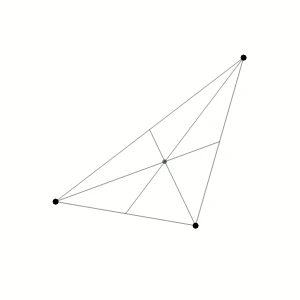
The Three-Book Structure
Three suns, three books, one inescapable entropy: the cosmos as a game with no stable solution.

The Three-Body Problem trilogy by Liu Cixin is a three-part science-fiction epic whose structure mirrors the very physics that gives it its name: a system of three gravitationally interacting bodies with no stable, predictable orbit. Book one grounds the story in the human trauma of the Cultural Revolution and a single physicist's fateful contact with an alien species. Book two escalates to the strategic and philosophical博弈 between two civilizations locked in a cosmic game of hide-and-seek. Book three stretches the lens to the ultimate fate of matter itself, collapsing billions of years into a single narrative breath. Together, the three books form a tightening spiral—from one woman's secret, to a species' survival, to the entropy of everything.
- Author
- Liu Cixin (刘慈欣)
- Number of books
- 3
- Book titles (Chinese)
- 三体 / 黑暗森林 / 死神永生
- Book titles (English)
- The Three-Body Problem / The Dark Forest / Death's End
- Central conflict
- Humanity vs. the Trisolaran civilization
- Key strategic concept
- The Dark Forest theory (cosmic survival as zero-sum concealment)
- Narrative time span
- Cultural Revolution era through the heat death of the universe
Lore & Background
The trilogy's architecture is not merely a publishing decision; it is a narrative expression of the three-body problem itself. Just as no closed-form solution exists for predicting the long-term motion of three gravitationally bound bodies, the story refuses to settle into a single stable narrative mode. Each book shifts the gravitational center: Book one orbits the personal (Ye Wenjie's betrayal, Wang Miao's investigation, the eerie card game that simulates stellar chaos). Book two orbits the strategic (the Dark Forest logic, the exposure of the ETO, the 450-year countdown). Book three orbits the cosmological (deterrence, dimensional warfare, the final dissolution of matter into radiation). The reader is never given a fixed reference frame, only the sense that the system is always on the verge of a new, unpredictable configuration.
The Dark Forest theory, which becomes the trilogy's governing metaphor, recasts the Milky Way as a night forest where every civilization is a silent hunter. To reveal your position is to invite annihilation. This principle, Liu Cixin argues, explains the Great Silence: the universe is not empty, it is full of beings who have learned that the only safe strategy is to stay dark. The three-book structure enacts this logic on the reader—each book strips away a layer of comfort, a layer of assumed safety, until what remains is the cold, featureless dark.
The Trisolaran home world, orbiting three suns in a chaotic dance, is the physical embodiment of this instability. Seasons last decades or hours. The civilization's entire technological and cultural history is a record of survival through unpredictability. When they set their eyes on Earth—a stable, single-sun world with a predictable climate—they are not merely invaders; they are refugees fleeing chaos for order. This inversion, that the aggressor is the one who most desperately wants stability, is the trilogy's quietest and most devastating idea.
In Their Own Story
The card table was bare wood, scarred with decades of chalk marks. Ye Wenjie dealt the three suitless cards face-down in a triangle, the way her father had taught her before the Red Guards came. In the simulation, the three suns were three points of light that never held still—one would flare, another would dim, the third would swing between them like a pendulum with no fixed axis. The Trisolaran players called it a game. They called it a prayer. They called it the only honest description of their sky.
She flipped the middle card. A star. The other two went dark. In the simulation, the Trisolaran world would freeze for a generation. In the real world, a young physicist in a concrete bunker pressed a key she had not meant to press, and a signal left the solar system at the speed of light, carrying the one coordinate that could not be unsent.
Four hundred and fifty years later, the card table would be ash, the bunker would be a museum, and the three suns would still be swinging. The game, as always, had no ending. Only the next turn.
Reader's Guide
BEAT 1 — Cultural Revolution (1960s–70s): A young physicist, Ye Wenjie, endures political persecution at a remote facility. Her disillusionment with humanity drives her to make first contact with the Trisolaran civilization, a species whose home world orbits three suns in a chaotic, unpredictable pattern. She sends a warning, then—bitter and broken—sends Earth's coordinates. The Trisolaran fleet is launched. Consequence: a 450-year countdown begins. Liu Cixin anchors the cosmic in the deeply personal, making the betrayal feel intimate rather than geopolitical.
BEAT 2 — 2007, the contemporary era: Wang Miao, a materials scientist, is pulled into a web of unexplained deaths and a bizarre card game that simulates the three-star chaos. The ETO is exposed. Liu Cixin compresses what would be decades of preparation and political maneuvering into a single tense year, letting the reader feel the countdown rather than watch it tick. Consequence: humanity learns the fleet is coming, and the Dark Forest logic becomes the governing strategic principle for every subsequent decision.
BEAT 3 — 22nd century and beyond: The Trisolaran fleet approaches. A scholar weaponizes the Dark Forest theory into a deterrent. Liu Cixin leaps forward in enormous jumps—centuries, millennia—compressing the long middle of the conflict into a handful of scenes. Consequence: the fate of both civilizations is sealed not by a single battle but by the cold arithmetic of cosmic survival, where the safest move is to stay silent.
BEAT 4 — Heat death: The final book stretches to the end of all matter. Liu Cixin skips billions of years in a single paragraph. The three-star chaos, the dark forest, the weapons of one dimension against another—all dissolve into entropy. Consequence: the trilogy's structure itself becomes a metaphor for the three-body problem—no stable orbit, no final answer, only the slow, inevitable fade into uniform darkness.
Did You Know?
- The 'three-body problem' in classical mechanics asks whether the long-term motion of three gravitationally interacting bodies can be predicted exactly. It cannot—there is no general closed-form solution. Liu Cixin uses t
- The Trisolaran home world's three-sun system produces a climate so chaotic that the civilization's entire history is a record of surviving unpredictable seasons—some lasting hours, others decades. Their desire for Earth
- The Dark Forest theory is Liu Cixin's original speculative concept, not drawn from existing astrophysics or game theory. It reframes the Fermi Paradox (why we see no aliens) as a survival strategy: the universe is full o
- All three books were published in Chinese in 2008, meaning the full 200,000-year narrative arc was conceived and delivered as a single, continuous project rather than a decades-long series.
More in Narrative Arcs & Timeline
Elsewhere in the The Three-Body Problem universe
Spotted an error? Know more?
This is a living reference — every entry is fact-audited, and reader corrections feed straight into our audit queue. Suggest an edit · See this site's audit record